

MANUKA HONEY – A MIRACLE CURE FOR WOUND HEALING AND REGENERATION?
Manuka honey is known for its regenerative, powerful antibacterial, antioxidant, and wound-healing properties. It also forms a protective barrier on the skin.
What is Manuka honey?
In recent years, New Zealand Manuka honey has become increasingly well known and important.
Manuka honey is obtained from the nectar of the flowers of the Manuka shrub Leptospermum scoparium. It is native to the mountainous regions of New Zealand and parts of Australia. The indigenous people of New Zealand have been using it for centuries as an anti-inflammatory and anti-infective agent due to its strong antibacterial properties. The antibacterial effect is due to the high content of methylglyoxal (MGO) in Manuka honey, in contrast to conventional honey. Honey also contains valuable vitamins, acids, and hydrogen peroxide and has a positive effect on the immune system. Manuka honey has over a hundred times more MGO than standard honey.
What is MGO?
MGO (methylglyoxal) is found in Manuka honey and is known for its antibacterial and healing properties. The MGO concentration in Manuka honey is often used as a measure of its quality and effectiveness. The higher the MGO content, the stronger the antibacterial properties of Manuka honey are, as a rule. MGO inhibits bacterial growth.2 Depending on its content, Manuka honey is suitable for use in wound healing for external treatment or internal application. However, higher MGO contents are common for internal treatment.
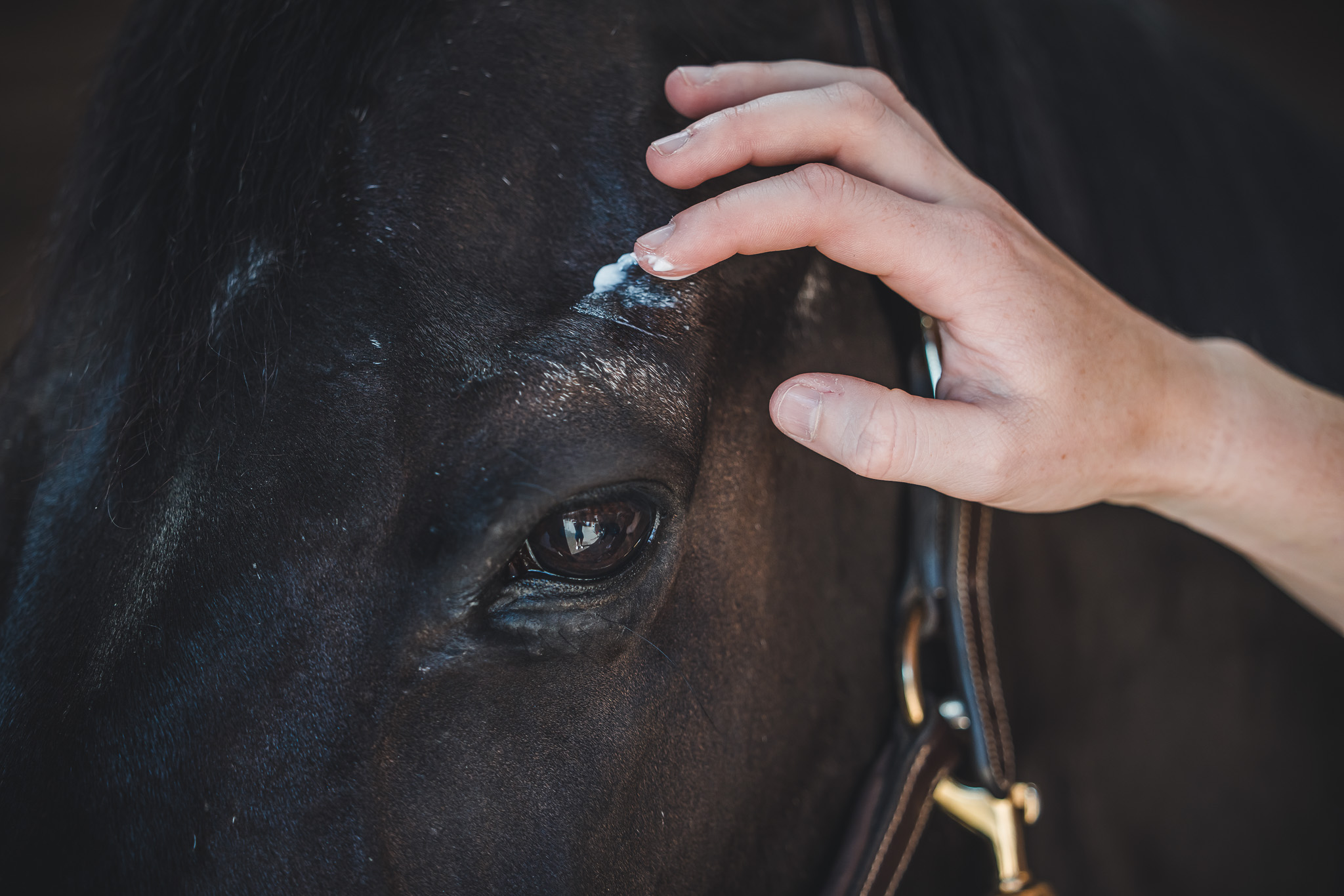
Does your horse have stressed and sensitive skin?
A horse's skin plays an essential role in its overall health and well-being. It is the body's outermost protective layer and first barrier against external influences, and fulfills a variety of physiological tasks. In addition to its mechanical protective effect and its role in preventing uncontrolled fluid absorption or fluid loss from the body, its thermoregulatory function and its role as the largest sensory organ and immune organ are also extremely important. A horse's skin can be stressed by infections caused by parasites, viruses, and bacteria, allergies, mechanical irritation (e.g., chafing), extreme weather conditions, skin diseases such as summer eczema or mud fever, and malnutrition. Skin care and regular checks are therefore extremely important in order to detect and treat skin irritations at an early stage.
What effect does Manuka honey have?
Its high antibacterial properties, which are due to its high MGO content, prove particularly promising in the treatment of wounds.4
1See Gemingnani et al. (2020)
2See Bester et al. (2016)
3See Aschenbach et al. (2019)
4See Gemingnani et al. (2020)
How does wound healing with Manuka honey work?
Manuka honey is used as a wound dressing to create a moist wound environment. Moisture promotes cell migration and the formation of new tissue, which accelerates the healing process.5 It is said to be able to constantly disinfect itself, seal the wound from the outside and supply it with important nutrients.
In addition, Manuka honey has high osmolarity, high sugar content, and low pH, which inhibits microbial growth as the osmotic pressure draws water out of the bacterial cell.6 At the same time, wound exudate is drawn from the surrounding tissue into the wound, which helps to keep the wound clean.
It stimulates the bactericidal effect of phagocytes (macrophages) and, in chronic wounds, reduces enzyme activity and increases the activity and oxidation of fibroblasts, which contributes to the formation of new tissue and rapid wound closure.7
Interesting fact: When tissue is damaged, fibroblasts migrate to the wound and attempt to repair the damaged tissue. However, excessive activation can lead to scarring due to excessive collagen deposits.8
Manuka honey also supports the natural process of removing dead tissue, which facilitates the growth of healthy tissue and further reduces the risk of infection.9
The biological effect of Manuka honey on wounds is achieved by stimulating phagocytes, which destroy pathogens that have entered the body. This accelerates tissue turnover and forms a protective surface barrier, shortening the healing time.10
5See Mandal et al. (2011)
6See Mandal et al. (2011)
7See Dahiya et al. (2018)
8See Jordana et al. (1994)
9See Dahiya et al. (2018)
10See Gemingnani et al. (2020)
ASCHENBACH, J.R., GÄBEL, G., RACKWITZ, R., PEES, M. (2019): 10. Leipziger Tierärztekongress: Tagungsband 2, Leipziger Blaue Hefte, 97-99.
BESTER, M.J., GASPARAR, R.M., OBERHOLZER, H.M., RABIE, E., SEREM, C. (2016): How Methyglyoxal kills bacteria: An ultrastructural study. Ultrastructural Pathology, Volume 40, Issue 2, 107-111.
DAHIYA, D., JOHNSTON, M., MCBRIDE, M., OWUSU-APENTEN, R., SINGH NIGAM, P. (2018): Antibacterial activity of Manuka honey and its components: An overview, AIMS Microbiology, 4(4): 655-664.
GEMIGNANI, F., IACOPETTI, I., MARTINELLO, T., PATRUNO, M., PERAZZI, A. (2020): Hyaluronic acid, Manuka honey and Acemannan gel: Wound-specific applications for skin lesions. Research in Veterinary Science, Volume 129, 82-89.
JORDANA, M., RAMIS, I., SARNSTRAND, B., SIME, P., J. (1994): Immune-inflammatory functions of Fibroblasts. European Respiratory Journal, 7, 2212-2222.
MANDAL, M., MANDAL, S. (2011): Honey: its medicinal property and antibacterial activity. Asian Pacific Journal of Tropical Biomedicine, 1(2), 154-160.